
Tech Giants Cut Jobs to Fund AI, While Money Circulates Among Giants—What's Going On?
I recently saw a Reddit post and comments that deeply analyzed today's "AI hype" and criticized how capital is playing the AI narrative:
https://www.reddit.com/r/ArtificialInteligence/comments/1oj52xx/tech_companies_are_firing_everyone_to_fund_ai_but/
China's capital market has also been hyping AI (especially hardware) for quite a while—some narratives even reach "the U.S. is running out of electricity" levels. Based on that article, I want to talk about the phenomenon: big tech companies are laying people off while pouring massive money into AI. What is behind this, and how should ordinary people view it rationally?
1. The Core Tension: Why Layoffs and AI Spending Coexist
First, the headline contradiction: layoffs have continued across tech. For example, Amazon reportedly planned to cut 30,000 jobs, the largest in its history. Microsoft cut 15,000, Meta cut 3,600, Google cut hundreds. So far, 2025 tech layoffs have exceeded 180,000.
In sharp contrast, these companies keep increasing AI investment. In 2025, total AI spending across big tech exceeded $300 billion, far more than the costs saved via layoffs. Many companies also justify layoffs with "AI replacement" narratives:
- Zuckerberg: AI can do the work of mid-level engineers in writing code
- Amazon CEO: many roles will not require humans in the future
- Salesforce: cut 4,000 support staff due to expanded AI usage
- IBM: cut 8,000 HR roles claiming AI can handle administrative work
That leads to a key question: if AI replaces jobs and reduces costs, why does spending massively exceed savings? Where is the money going?
2. Where the Money Goes: A Closed Loop Among Giants?
The Reddit post argues that AI money largely circulates among tech giants, creating the appearance of growth without necessarily generating new profits.
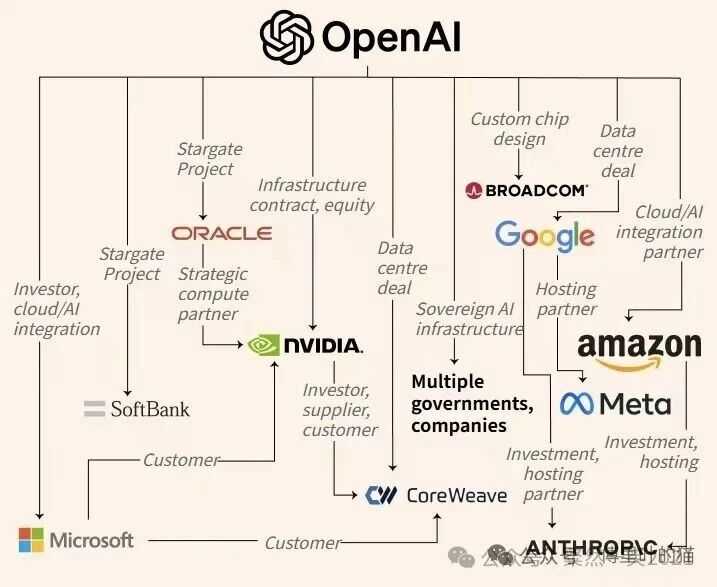
Examples of the cross-loop:
- Microsoft buys Nvidia chips and also rents AWS services
- Amazon buys Nvidia chips and also uses Microsoft software
- Meta buys Nvidia chips and rents infra from Google Cloud and AWS
- Even Apple largely rents Google/AWS/Azure instead of building full AI infra itself
Money forms loops: Apple pays Google for services; Google buys Nvidia chips; Nvidia pays TSMC; Microsoft pays Amazon for cloud; Amazon pays Microsoft for software. From a financial reporting perspective, everyone looks like they are growing—but profits are not necessarily new.
The "Magnificent 7" (Apple, Microsoft, Nvidia, Amazon, Alphabet, Meta, Tesla) together have about $17T market cap (U.S. GDP ~ $30T). But in 2024 their combined revenue was ~$2.2T and net profit ~$550B. Their average P/E is ~35, while the rest of S&P 500 averages ~15.5.
Investors accept high valuations because they expect AI to generate profits later. Yet in current reality, aside from Meta having some AI-related revenue, most AI spending has not become clear profit.
Worse, there is a spending inertia: if a company reduces AI investment, the stock may drop immediately because the market reads it as "giving up AI". So even without profits, companies keep spending, creating an AI arms race.
Capex growth reinforces this: in 2024, Microsoft/Amazon/Alphabet/Meta capex grew 42% YoY; in 2025 they planned another 17% increase. Just these four could spend ~$244B capex in 2025, much of which flows to Nvidia → TSMC → ASML, again forming loops.
This also links to ordinary people: much of U.S. retirement savings (401k) sits in S&P 500 index funds, meaning a meaningful portion is indirectly betting on the Magnificent 7 AI story.
3. A Mix of Views from Reddit Comments
The comment section included many positions. A few representative themes:
Where do laid-off workers go? Some argued that AI now becomes a survival tool: employers use AI to screen resumes, job seekers use AI to write resumes.
This is not a bubble, it's infrastructure. Others argued compute is the competitive moat, and infrastructure build-out takes 10–15 years.
ROI transparency is missing. Companies spend billions yet rarely explain what value AI spending yields; measurement frameworks should become standard.
What should ordinary people do? Do not panic, but abandon the illusion of stable big-tech jobs; learn AI tools and stay competitive. "You do not control the market cycle; you control whether you are the one being cycled."
Small companies get squeezed. Big players can cut prices and crowd out startups that cannot get chips or cloud discounts.
AI replaces some roles, not all. Repetitive roles can be automated; high-end work still needs humans.
Supply chain risk. Too much dependence on Nvidia + TSMC creates systemic fragility.
Consumer impact. Cloud prices and subscription costs may rise under the banner of "AI upgrades".
Regulation. Some called for clearer disclosure on AI spending and its labor-market impact, plus antitrust.
4. Closing: How Should We View This AI Wave?
AI clearly has real value: it can raise efficiency and improve services. But there is also plenty of "false heat": layoffs justified by AI narratives, growth optics created by closed-loop spending, and risks pushed onto investors, ordinary people, and smaller companies.
Different groups should react differently:
- Tech workers: learn AI tools and move toward higher-end work that is harder to replace; avoid tying your career to a single company.
- Investors: focus on real AI revenue and business models, not only narratives.
- Consumers: be cautious about price increases justified as "AI upgrades"; watch where savings are invested.
- Policymakers: require disclosure, strengthen antitrust, support smaller companies, and reduce single-point supply chain risk.
In the end, the AI narrative must land in people's phones and computers—not remain only inside data centers.