So I Was the Little Brother of the Zhu Family
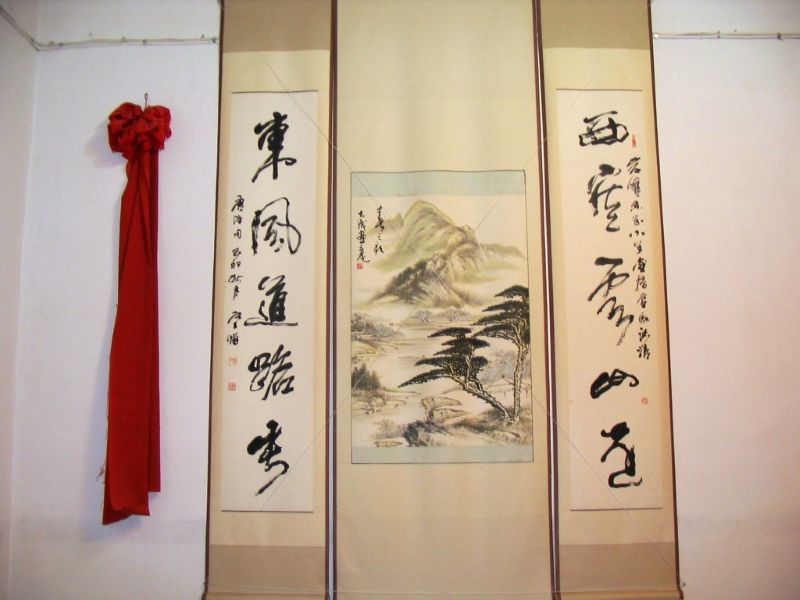
This couplet has long hung in my home: "Cloudy mountains beyond Xisai, long roads under the eastern wind." Behind it lies an interesting story.
After I was admitted to Peking University, the well-known county calligrapher Zhu Liangda was extremely excited when he heard the news. He wrote this couplet in flowing ink and personally brought it to my home.
Even though I still do not really understand calligraphy, I was of course impressed at the time. I immediately hung it in the living room and even found a painting to match it, so that the whole house suddenly looked cultured.
What I only learned later is that the most interesting thing in the couplet was how he referred to me. On it he signed me as "the little brother of the Zhu family." When my father first showed it to me, I was puzzled: Zhu Liangda was nearly twenty years older than my father. Calling him grandfather would not have been excessive. So why would he call me his little brother?
That is where traditional Chinese generational naming comes in. Put simply, he and I both belonged to the same generation marked by the character liang.
According to the Zhu genealogy of Jingde, boys in the family were named in sequence following the line: Yong shou jia ze, de mao yuan liang, xue yu xian zheng, wen zhi qi guang. For example, my father's generation used the character yuan in the middle of their names, and by that order my generation used liang. In a way, the logic is simple: each generation cycles through the sequence in turn.
I have not researched in detail why such generational naming was adopted, but the obvious function is that it made it easy for people of the same surname to identify seniority within the clan. In traditional society, etiquette between elders and juniors mattered greatly. At a first meeting, you could often tell immediately from the generation marker whether the person before you should be treated as an elder or a junior.
Of course, because of war, disease, and the branching of family lines over many generations, the age gaps within the same generation could become enormous. Or the opposite could happen: two people could be almost the same age while belonging to very different generations. One of my father's primary-school classmates belonged to the xue generation, so by strict logic he ought to have called my father "grandfather," which has always sounded rather funny whenever we talk about it.
Only after so many years have I come to appreciate the deeper meaning in the couplet Zhu Liangda gave me. The road of life is indeed a long one, and one should never let a momentary success blind oneself.