
Hiking Jingde Xishan and a Study of a 1506 Stone Pavilion Inscription
A Hike Up Xishan in 2005
In Jingde County town there are two hills: Zishan to the south and Xishan to the west. Jingde Middle School is at the foot of Zishan, so when I studied there, I climbed it many times.
Xishan is farther away. Jingde is not a big county town, but you still have to cross much of it to reach the trailhead. Even so, I did leave good memories there with friends.
This May Day holiday, with nothing in particular to do, I looked through old photos and found shots from May 3, 2005, when I climbed Xishan with Zhang Qipei, Zhu Yan, and Zhong Chen.
Back then we had only recently started working. We had hopes for the future, and also confusion about reality. But the hike itself was full of fun, and everyone seemed to return to the raw excitement of high school or even junior high, deep in the hills.
I even recorded a few videos on what was, at the time, an absolutely top-tier phone: the Nokia N82. On a modern screen they look like mosaics, but the audio is preserved well, and just listening with eyes closed is already enough.
After reaching the top, we descended on the side near the fluorite mine, walked back to the South Street of the county town, found a restaurant, and ate and drank heavily. Big bites of meat, big bowls of alcohol. It was thoroughly satisfying.
Looking at those photos now, I feel deeply nostalgic. Twenty years really pass in a blink.
After that trip, for various reasons, I never climbed Xishan again, and I never again rested with familiar friends in that small stone pavilion.
Later still, the high-speed rail era arrived at the foot of Xishan. The station there is busy, but I still miss that quieter and more innocent time.
On that hike, I photographed the inscription of the stone pavilion halfway up the mountain. This time, with the help of modern tools, I translated it as a small tribute to the past.
The inscription was written in the first year of the Zhengde reign of the Ming dynasty, in 1506—more than five hundred years ago. In front of that scale of time, my twenty years without climbing Xishan is almost nothing, and any worries of the human world are long washed away.
Some variant characters appear in the inscription, so the translation may differ slightly in details, but the main meaning is unaffected.
The text is short, plain, and concise. It does not even mention how much money was spent, which I find admirable.
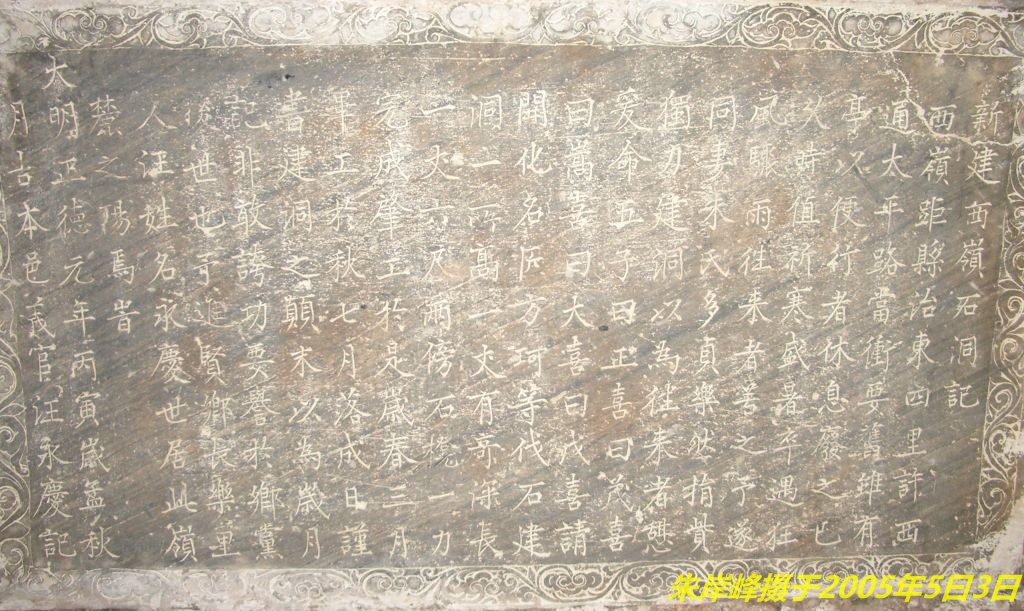
1. Classical Chinese (with punctuation)
Record of the Newly Built Stone Shelter on West Ridge
西岭距县治东四里许,西通太平路,当冲要。旧虽有亭,以便行者休息,废之已久。
时值祈寒盛暑,卒遇狂风骤雨,往来者苦之。予遂同妻朱氏多贞,乐然捐资独力建洞,以为往来者憩。
爰命五子,曰正喜,曰茂喜,曰嵩喜,曰大喜,曰戊喜。请开化名匠方珂等,伐石建洞。
一面高一丈有奇,深长一丈六尺,两傍石凳,一力完成。肇工于是岁春三月,毕工于秋七月。
落成日,谨书建洞之颠末,以为岁月记,非敢矜功要誉于乡党后世也。
予进贤乡长乐里人,汪姓名永庆,世居此岭麓之阳。马峙。
大明正德元年丙寅岁孟秋月,吉。本邑义官注永庆记。
2. English Translation
West Ridge lies about four li east of the county seat, and it connects westward to the Taiping Road, a key route. Though there once was a pavilion here for travelers to rest, it had long since fallen into ruin.
In severe cold or intense heat, and especially when sudden fierce winds and heavy rain arrived, travelers suffered greatly. Therefore, I, together with my wife Zhu Duozhen, gladly donated funds and undertook the work ourselves to build a stone shelter so that travelers might rest and take refuge from wind and rain.
For this purpose I called upon my five sons—Zhengxi, Maoxi, Songxi, Daxi, and Wuxi—and invited the famous stone mason Fang Ke from Kaihua and others to quarry stone and build the shelter.
The front face rises more than one zhang; its depth and length are one zhang and six chi. Stone benches were set on both sides. It was completed entirely by our family effort. Work began in the third month of spring and finished in the seventh month of autumn of that same year.
On the day it was completed, I carefully wrote down the beginning and end of the construction as a record for time. It is not that I dare to boast of merit or seek praise from neighbors or from later generations.
I am Wang Yongqing, of Changle Hamlet in Jinxian Township. My family has lived for generations on the sunny side of this ridge, at Mazhi.
On an auspicious day in early autumn, the first year of the Zhengde reign of the Great Ming (Bingyin year). Recorded by Zhu Yongqing, a local charitable official.
3. Original Inscription Text
新建西嶺石洞記
西嶺距縣治東四里許西
通太平路當衝要舊雖有
亭以便行者休息廢之巳
久時值祈寒盛暑卒遇狂
風驟雨徃来者苦之予遂
同妻朱氏多貞樂然捐貲
獨力建洞以為徃来者憩
爰命五子曰正喜曰茂喜
曰嵩喜曰大喜曰戊喜請
開化名匠方珂等伐石建
洞一㪽髙一丈有竒深長
一丈六尺兩傍石櫈一力
完成肇工於是歳春三月
畢工於秋七月落成日謹
書建洞之顛末以為歳月
記非敢𧩊功要譽於鄉黨
後世也予進賢鄉長樂里
人汪姓名永慶世居此嶺
麓之陽馬峕
大明正德元年丙寅歳孟秋
月𠮷本邑義官注永慶記