Ancient Poetry Related to the Name "Anfeng"
For a long time I have wanted to find a line of classical Chinese poetry into which my own name could fit. That way, when introducing myself, I might sound unexpectedly impressive. In fact, I had this idea more than ten years ago. Back then, domain grabbing was still very fashionable, and short phrases from classical poems were especially popular. The most typical example is Baidu. Leaving aside everything else, the name itself is excellent: "among the crowd, I searched for him a thousand times." It fits the meaning of a search engine perfectly. Baidu, I used to think, held a rather strong hand, but looking at its development in AI today, it has not lived up to expectations. It gives the impression of having started early only to arrive late.
Actually, many years ago I once asked my father what the name "Anfeng" meant. He said it came from this line:
海到尽头舟做岸,山登绝顶我为峰。
I asked him how he knew that line. It was something from the 1980s, and he naturally could not remember clearly. Most likely he came across it by chance while writing Spring Festival couplets. In those days, anyone willing to use such a line in a couplet must have been a fairly open-minded person.
Years later, I looked it up and discovered it was not a couplet after all. The source was actually Lin Zexu's Chu Lao:
(As an aside: sometimes the things we take for granted are exactly the things most worth examining closely.)
Chu Lao
Lin Zexu
海到尽头天作岸,山登绝顶我为峰。
如日东山能再起,大鹏展翅恨天低。
Lin Zexu needs no introduction. What I am curious about is the background of this poem. We all know he lived a rich and dramatic life, and he even went to Xinjiang.
I searched around and found no authoritative explanation. Some people say it was written in his youth. That does make sense. The poem carries a young person's wild boldness. It does not feel like something written in the smoke of Humen.
(Wait a second. Does the second half of the poem imply that I too may rise again? Haha.)
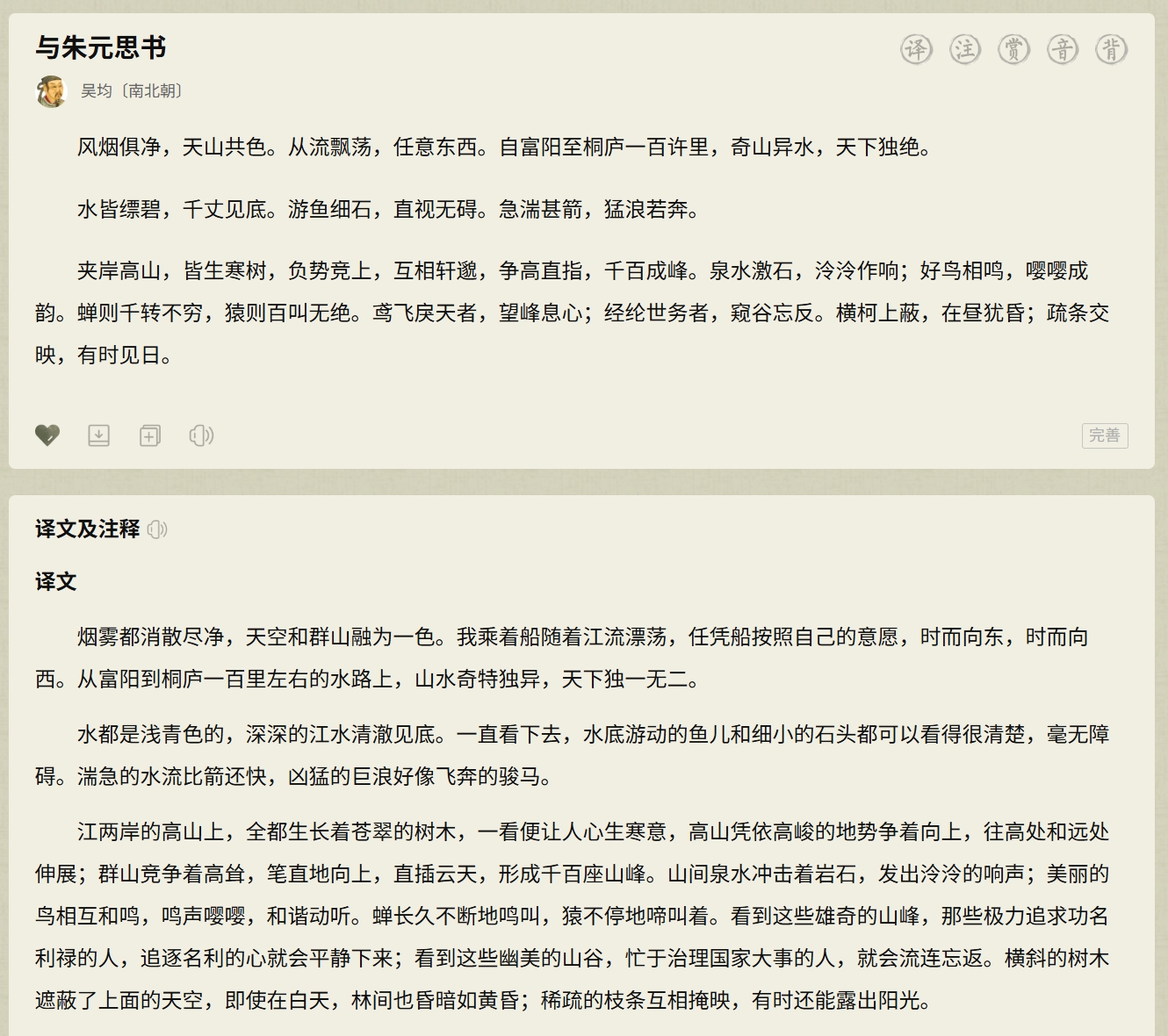
Of course, there is also another classical text that suits the feeling of "Anfeng," and it is much older, from the Northern and Southern Dynasties, nearly sixteen hundred years ago.
The author wrote it while traveling by water from Fuyang in Zhejiang to Tonglu. By coincidence, those places are not far from my hometown in Xuancheng, and the scenery was probably not too different.
Another coincidence is that the essay was written to Zhu Yuansi, who shares my surname.
When it comes to ancient poetry and prose, all I can feel is admiration: