
Thoughts on the Film *Arrival* (2016)
Why I Started
Taopiaopiao has a small feature that I genuinely appreciate: it keeps all of your historical orders. That is relatively rare among today's big internet apps, where the common approach is to keep only a limited window of order records.
Taopiaopiao is different. When I checked my account, even records from 2015—ten years ago—were still there. Perhaps that is simply because the total volume of movie ticket orders is not as massive as in other businesses.
Anyway, on January 24, 2017, I watched Arrival. To be honest, as a sci-fi fan, I was slightly disappointed at the time: the pacing felt slow, the plot felt obscure, there were no grand Star Wars-style spectacles, and it was not scary like Alien either.
Clearly I was not drawn in by the director's name. I had no idea who Denis Villeneuve was back then. If I had to be honest, beyond the sci-fi theme, I was probably also there for the lead actress Amy Adams. I have always found her beautiful. I also like the idea that truly "tough characters" should have alliterative names: Peter Parker, Bruce Banner, Bucky Barnes, Stephen Strange.
Recently, after rewatching the film through several Bilibili movie critics, such as Movie Has Luo Ji and Movie Top, my view changed.
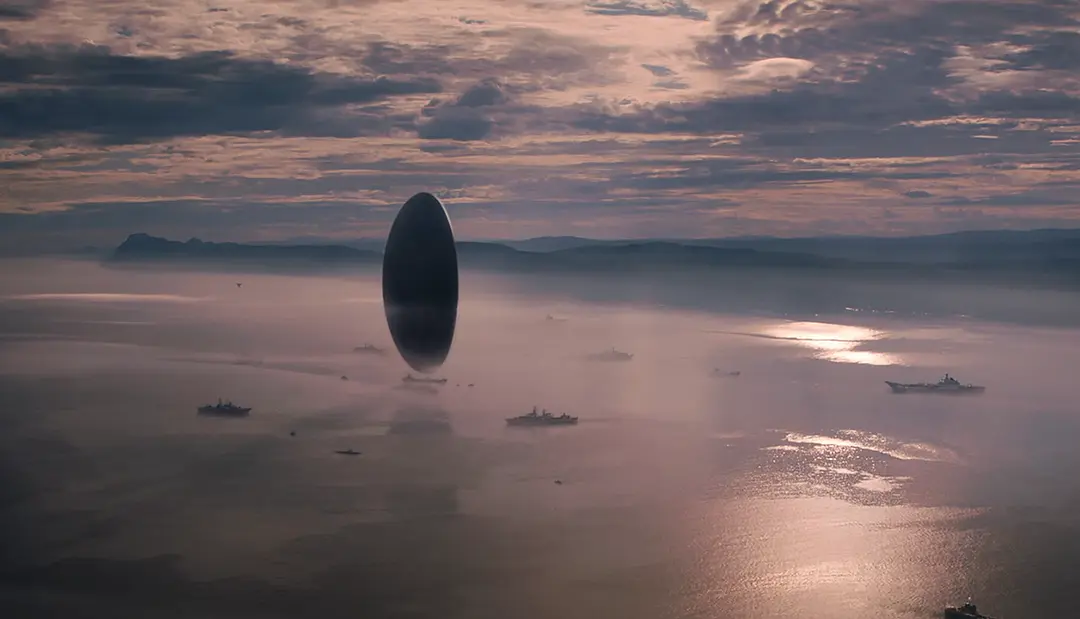
Years ago, Liu Cixin once said in an interview that we do not lack interesting sci-fi ideas; what we lack are good stories. Arrival is worth watching because it is a good story.
Language as a Way of Thinking and Communication
People who speak different mother tongues often see the world differently. We all have the experience of learning foreign languages. Take English: just 26 letters, plus countless inversions and long complex sentences, and you cannot help thinking, "Why do foreigners like expressing things this way?" Chinese writing, on the other hand, is pictographic and carries meaning. That makes many Chinese readers more comfortable with a hazier kind of beauty, because pictographic meaning requires associative understanding, in other words, it requires guessing and insight.
When we think, our minds either form images or use language to describe. So our thinking is influenced by language. The core idea of Arrival (based on the original story "Story of Your Life") is this:
Human language is written and spoken linearly, from beginning to end. So human thinking is also linear, and our sense of time runs from past to future. But what if there were a language that was not linear? If humans mastered such a language, their thinking might also become non-linear. Their perception of time would become non-linear as well. And non-linearity implies mixing, even loops: the past and the future are not a simple cause-and-effect chain, but parallel.
In a different way, this essay touches on a similar point.
This also reminds me of today's large AI models. Their training data is mostly human text, so they learn human ways of thinking and communicating. That may help explain why current AI still struggles to surpass humanity in its understanding of the universe.
Is This Fatalism?
This story is not really promoting fatalism. Fatalism claims that past and future are fixed and unchangeable. What the story emphasizes is that language shapes thinking. It imagines a non-linear sense of time, and once time itself is not linear, simplistic fatalism becomes difficult to even formulate.
When you watch this work, do not fixate on predicting the future, or on things like the grandmother paradox. The story is not trying to argue that. It is trying to convey the idea that different languages can generate different patterns of thinking, including different ways of understanding time.
A Good Story
Personally, I find this sci-fi idea deeply striking. There are no planet engines or sophons here, but the author cleverly ties language to cognition, and ties cognition to time, creating a story that feels both mind-blowing and romantic.
Do not overthink it. Feel it. Feel the imagination behind it.