
Ode to Zhuwang Village
Author: Zhu Jianrong. Written in 2020. Zhuwang Village in Jingde County, Anhui, is the author's hometown and also one of the millennium-old villages of southern Anhui.
The Daxi River[1] winds and flows to the southeast,
Through the village runs a man-made nine-bend canal.
Turtle Hill lies to the east, Dragon Ridge[2] to the west,
Gateway to the "Anhui-Sichuan-Tibet" road of southern Anhui.
An eight-li embankment guards both banks,
A thousand mu of fields shimmer like golden waves.
By Xianyun Terrace, one fishes at Dragon Pool[3],
Under Shengwu Bridge[4], ducks and geese play.
High-speed trains pass above the Six-Mu Pond,
By the old buckwheat hermitage and the "third-front" buildings[5].
Beneath the Thirteen Bridges[6], nine well-shadows linger,
By Ninety-Nine Dangs, Bai-Mu E rises[7].
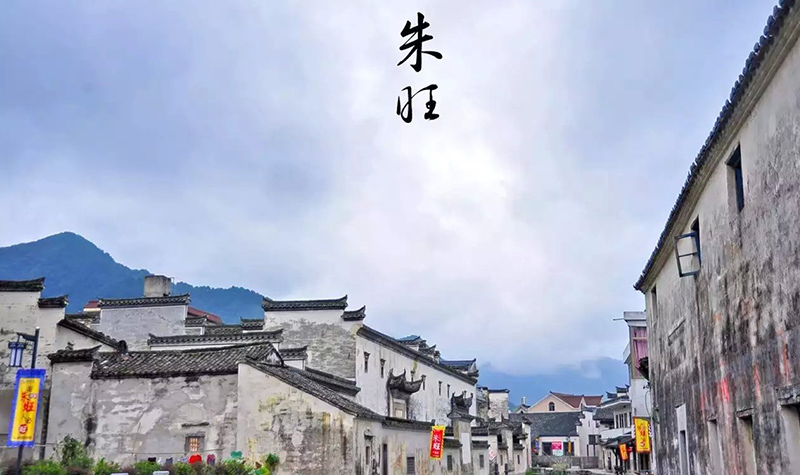
White walls and dark tiles stand in dense rows,
Who knows how many alleys hide in depth.
Virtue and learning are honored; neighbors live in harmony,
Zhu Jia and Zhu Jiannong[8] remain in history's record.
Irrigation channels nourish the fields; the Half-Moon Well[9] reflects,
All the village sings like a Jiangnan water town.
Where is the ten-thousand-seat opera stage now,
Only day-trip flags stand high at the village gate.
Ten-li Three Villages[10] won the first fame,
In southern Anhui's heartland, the peach-garden joy remains.
Notes:
The Daxi River flows eastward from Fushan, circles the village, and then flows south into the Huishui River near Caijiaqiao. ↩︎
To the east of the village is Turtle Hill; to the west is the ridgeline of the "incoming dragon" mountains. ↩︎
In the hills behind the village once stood Xianyun Terrace. It is said that Zhu Zedan, a Hanlin scholar, studied there in his youth. It was destroyed during the Cultural Revolution; only the cliff inscription "Xianyun and Pool Reflections" remains. ↩︎
Shengwu Bridge is a stone-beam bridge over the Daxi River on the eastern side of the village, now commonly called "New Bridge." ↩︎
Behind the village were the ancient Buckwheat Hermitage and Xiangyun Temple, with nearly a thousand years of history. In the Qing dynasty, the Yongzheng Emperor (Prince Yong) is said to have inscribed a plaque reading "Fuhu Zen Temple." It was destroyed during the Cultural Revolution, and only scattered foundation stones remain. In the 1970s, Shanghai built a "third-front" factory here known as Xinghuo Factory. ↩︎
Thirteen granite stone bridges span the man-made canal in the village, and nine stone wells are stacked along the canal from downstream to upstream. ↩︎
On the front hill of the village there is a stone-paved road nearly two meters wide that leads via Honglingjian to a hilltop "Hundred-Mu Garden." In the garden stands a "Five-Grain Tree" more than a hundred years old. It is said the tree blooms with five different kinds of grain flowers, and whichever flower blooms most foretells a bumper harvest of that grain. ↩︎
Zhu Jia was one of the leaders of a peasant uprising in Sichuan during the revolutionary period and was killed after its failure. Zhu Jiannong joined the underground Party in his youth and later became a professor at Wuhan University and a noted economist. ↩︎
In Xingtian within the village there is a stone-built irrigation channel that draws water from the Daxi River. Beside it sits a stone well shaped like a half moon, with the arc facing south and the chord facing north. ↩︎
Ten-li Three Villages refers to Zhuwang, Tangcun, and Qiaoting. ↩︎