
After Watching a Talk by Yang Zhenning - From "Not Interested" to Admiring His Thinking and Candor
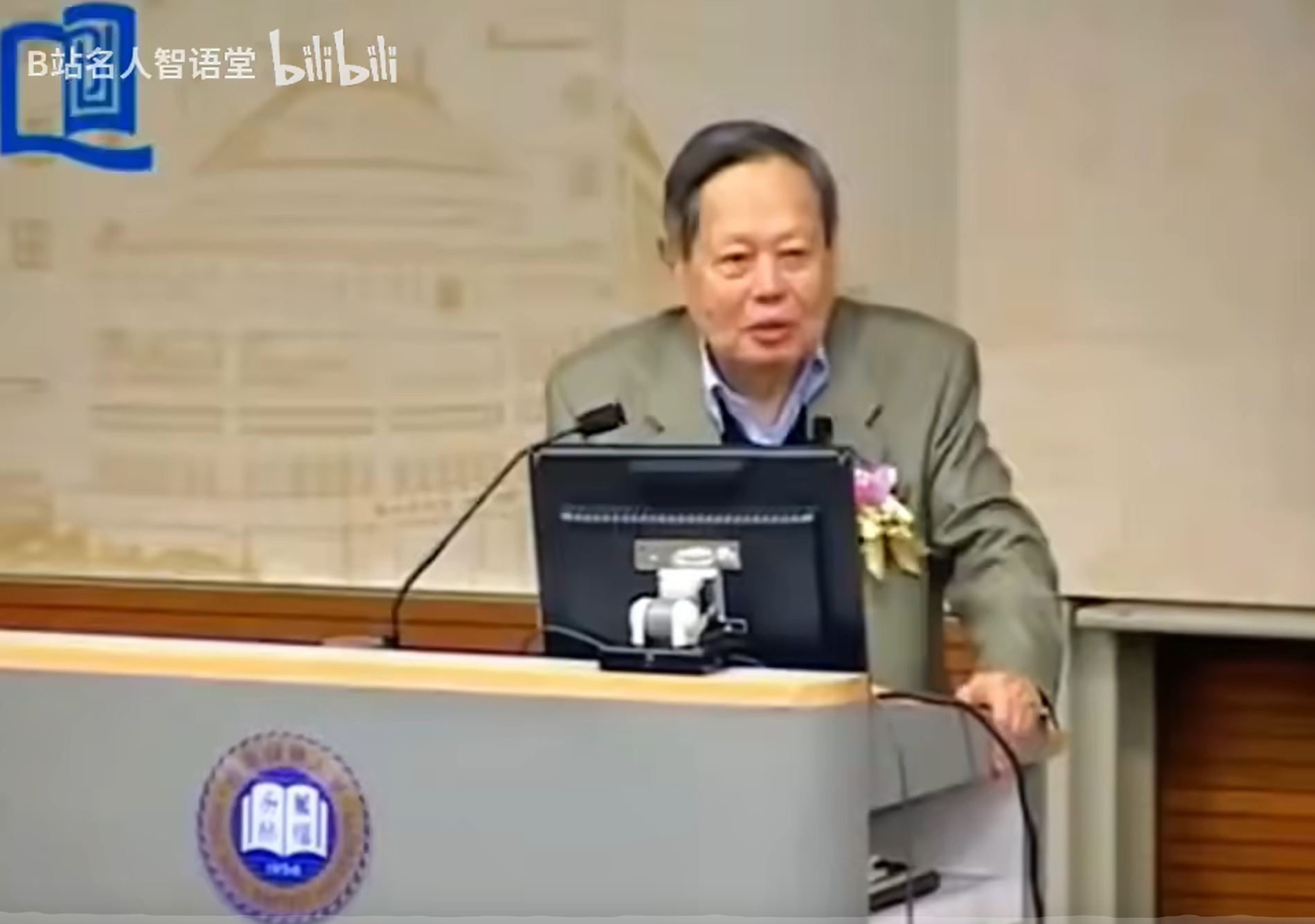
One of the most direct ways to know someone—especially a famous person—is to listen to their talk.
I had heard of Professor Yang Zhenning and some of his achievements long ago, but due to my limited understanding of physics and other reasons, I was not very interested in his life story. To be honest, I was more intrigued by that line in The Three-Body Problem—"physics does not exist"—than by Yang's biography.
Today, I randomly came across an old talk of his on Bilibili:
https://www.bilibili.com/video/BV1KqRiYdErA/
It gave me several new realizations. The video does not label the exact date, but it appears to be around 2012, recorded when he was in his eighties, likely at Hong Kong Baptist University. Even though the playback speed was artificially increased, I could still strongly feel how clear his thinking remained at that age: he switched between Chinese and English smoothly, recalled major events without much stumbling, and kept the thread intact. That is genuinely impressive.
Humor was my first impression. As a physics legend, I expected a wall of difficult jargon. Instead, even some viewers said "even liberal arts students can enjoy it." I myself went from sleepy to engaged—almost like listening to traditional storytelling. To me, one key trait of true masters is the ability to explain a theory or a logic chain clearly and vividly, step by step. The talk also included many photos and stories of historical figures such as Einstein, Enrico Fermi, Jim Simons, Huang Kun, Deng Jiaxian, and Wu Chien-Shiung, which made it even more engaging.
Sincerity was the other striking trait. He openly discussed life experiences and did not avoid questions, such as comparing Chinese vs. Western education styles (deductive vs. inductive). He even shared academic failures and offered practical advice.
For example, he used a high school centripetal-force problem and suggested:
"When your intuition conflicts with what the textbook says, that's the best moment to learn."
Other advice that stayed with me:
- Do not abandon a good idea too easily; you can shelve it and return when you learn something new.
- Learn by infiltration: if you do not understand once, listen multiple times and you will gain something.
- Cultivate interest first, then prepare seriously—only then can you produce results.
- Effort that does not succeed may still have value; perhaps the timing is not right.
- When research hits a bottleneck, consider whether to adjust direction and go with the trend.
Looking at Yang's journey, my takeaway is simple: in a long life, meeting someone who can guide you at a critical moment can matter immensely. It can be the key factor that helps you break out of your own circle.